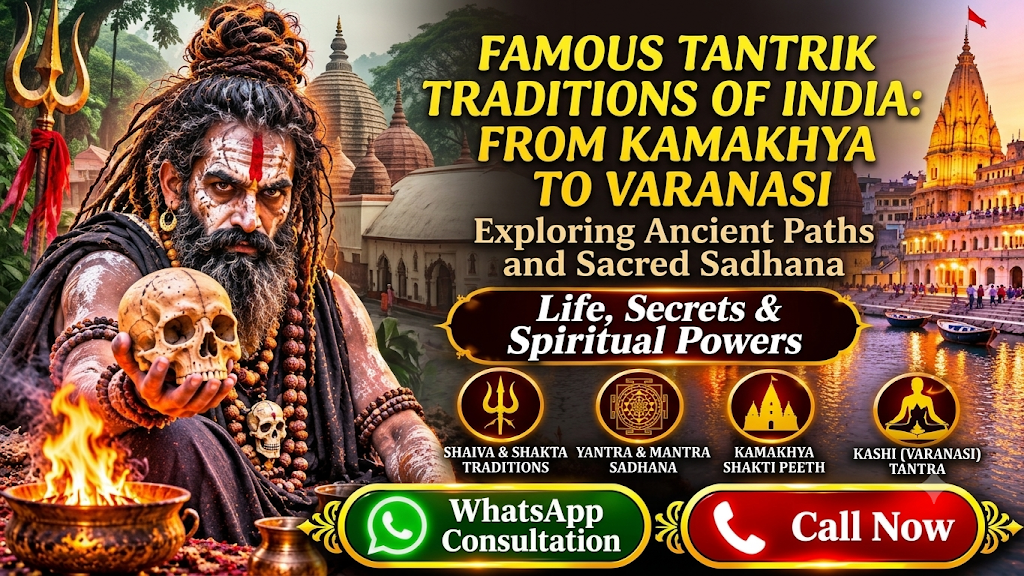
India has a rich and diverse spiritual history associated with Tantra (तंत्र), Tantrik Vidya (तंत्र विद्या), Shakti Upasana (शक्ति उपासना) and Shaiva traditions (शैव परंपरा). Across different regions of the country, ancient spiritual practices have developed around Goddess Shakti, Lord Shiva, sacred mantras, meditation and traditional forms of worship.
From the famous Kamakhya Temple in Assam to the ancient spiritual city of Varanasi in Uttar Pradesh, India is home to several important centres associated with Tantrik traditions. Places such as Tarapith in West Bengal, Kashmir and Kerala also preserve distinctive forms of Tantric philosophy and religious practices.
But what is Tantra really? Is it only associated with mysterious rituals, Aghori Babas and black magic, or does it have a deeper spiritual and philosophical meaning?
The truth is that Tantra is a broad spiritual tradition, not a single practice. It includes different systems of worship, meditation, philosophy and ritual discipline. Understanding its history helps separate traditional knowledge from popular myths and misconceptions.
This article explores the famous Tantrik traditions of India, their historical backgrounds, religious significance and connections with Lord Shiva and Goddess Shakti.
Table of Contents
| No. | Topic |
|---|---|
| 1 | What Is Tantra? Understanding Tantrik Traditions |
| 2 | Kamakhya Temple: The Famous Centre of Shakta Tantra |
| 3 | Varanasi: The Ancient City of Shiva and Tantrik Traditions |
| 4 | Tarapith: The Sacred Tradition of Maa Tara |
| 5 | Kashmir Shaivism: The Philosophical Tradition of Tantra |
| 6 | Kerala: Traditional Tantrik Temple Worship |
| 7 | Odisha: Shakti Worship and Tantric Heritage |
| 8 | The Connection Between Lord Shiva and Goddess Shakti |
| 9 | Mantra, Yantra and Tantrik Sadhana |
| 10 | Different Types of Tantrik Traditions in India |
| 11 | Myths and Reality About Tantrik Baba |
| 12 | Why Are Tantrik Traditions Still Important Today? |
| 13 | Frequently Asked Questions About Indian Tantra |
1. What Is Tantra? Understanding Tantrik Traditions
Tantra (तंत्र) is a broad group of Indian religious, philosophical and spiritual traditions that developed over many centuries. These traditions are found in Hinduism and Buddhism, with different schools following their own scriptures, rituals and spiritual approaches.
In Hindu traditions, Tantra is particularly associated with Lord Shiva (भगवान शिव) and Goddess Shakti (माँ शक्ति). Many Tantric systems explain the relationship between consciousness and divine energy.
The word Tantrik (तांत्रिक) generally refers to a practitioner or follower of a Tantric tradition. However, not every Tantrik follows the same path. Some focus on temple worship, some study sacred scriptures, while others follow particular forms of mantra, meditation and spiritual discipline.
Important Elements of Tantra Vidya
1. Mantra Sadhana (मंत्र साधना)
Mantra Sadhana involves the repetition, recitation and contemplation of sacred sounds or spiritual formulas. Mantras hold an important place in many Hindu Tantric traditions.
2. Yantra (यंत्र)
A Yantra is a sacred geometric diagram used in certain forms of worship and meditation. The Shri Yantra is one of the best-known examples associated with Shakta traditions.
3. Devi Upasana (देवी उपासना)
Devi Upasana means the worship of the Divine Mother in different forms, including Kali, Tara, Tripura Sundari and Bhuvaneshwari.
4. Dhyana (ध्यान)
Meditation and concentration are important components of several Tantric spiritual systems.
5. Tantrik Puja (तांत्रिक पूजा)
Tantric worship may involve specific mantras, offerings, ritual gestures and procedures according to the particular tradition.
6. Guru Diksha (गुरु दीक्षा)
Some Tantric lineages place great importance on initiation from a qualified spiritual teacher who guides the practitioner through traditional teachings.
In simple Hindi, Tantra केवल पूजा-पाठ या रहस्यमयी क्रियाओं तक सीमित नहीं है। यह दर्शन, साधना, मंत्र, ध्यान और आध्यात्मिक अनुशासन से जुड़ी एक व्यापक परंपरा है।
2. Kamakhya Temple: The Famous Centre of Shakta Tantra
Kamakhya Temple, situated on Nilachal Hill in Guwahati, Assam, is among the most recognised centres of Shakti worship and Shakta Tantrik traditions in India.
The temple is dedicated to Goddess Kamakhya, a manifestation of the Divine Mother. It is traditionally regarded as one of the important Shakti Peethas and has a special place in the religious history of Assam.
Why Is Kamakhya Temple Important in Tantra?
Kamakhya is particularly associated with Shakta Tantra (शाक्त तंत्र), a spiritual tradition that gives central importance to Goddess Shakti.
Unlike many Hindu temples where the main deity is represented through an idol, the principal object of worship at Kamakhya is a natural rock formation associated with the sacred Yoni.
The temple symbolises the creative and generative power of the Divine Mother.
Ambubachi Mela and Tantrik Traditions
One of the most important annual events at Kamakhya is the Ambubachi Mela (अंबुबाची मेला).
According to the traditional belief associated with the festival, Goddess Kamakhya undergoes her annual menstruation. The temple remains closed for a designated period and reopens after the ceremonial observance.
Thousands of devotees, religious practitioners and visitors come to participate in this festival.
Important Spiritual Associations
- Goddess Kamakhya worship
- Shakta Tantra and Devi Upasana
- Ambubachi Mela
- Shakti Peetha traditions
- Mantra and ritual worship
- Ancient religious traditions of Assam
Kamakhya is especially important for understanding the connection between Goddess Shakti, Tantrik Vidya and the Divine Feminine.
3. Varanasi: The Ancient City of Shiva and Tantrik Traditions
Varanasi, also known as Kashi or Banaras, is one of India’s most important sacred cities. Situated on the banks of the River Ganga in Uttar Pradesh, it has a long religious history associated with Lord Shiva, Shaivism, Shakti worship and different Tantric traditions.
Kashi is traditionally considered the city of Lord Shiva. Its temples, ghats, monasteries and religious institutions have attracted spiritual seekers for centuries.
Connection Between Varanasi and Tantra
Varanasi has historical connections with several Shaiva and Shakta traditions. The city is also associated with Bhairava worship, ascetic communities and particular Aghora traditions.
Some important spiritual locations include:
Kashi Vishwanath Temple
Dedicated to Lord Shiva, Kashi Vishwanath is one of the most revered Shiva temples in India. It represents the deep religious connection between Kashi and Mahadev.
Kal Bhairav Temple
Kal Bhairav is considered a fierce manifestation of Lord Shiva. He holds an important place in the religious traditions of Kashi.
Manikarnika Ghat
Manikarnika is one of Varanasi’s most famous cremation ghats. It is deeply associated with Hindu beliefs about death, liberation and the cycle of life.
Maa Annapurna Temple
Dedicated to Goddess Annapurna, this temple represents the nourishing and compassionate form of the Divine Mother.
Aghori and Tantrik Traditions in Kashi
Varanasi is particularly known for its association with Aghora traditions (अघोर परंपरा).
Aghora is a spiritual path associated with overcoming fear, attachment and distinctions between purity and impurity. Some Aghora traditions have connections with cremation-ground symbolism and Lord Shiva.
However, it is important to understand that Aghori and Tantrik are not interchangeable terms. Aghora represents a particular spiritual tradition, while Tantra includes many different religious and philosophical systems.
For this reason, Kashi remains an important place for studying the historical relationship between Lord Shiva, Aghora and Tantrik traditions.
4. Tarapith: The Sacred Tradition of Maa Tara
Tarapith, located in the Birbhum district of West Bengal, is an important pilgrimage centre associated with Maa Tara and Shakta Tantra.
The temple is dedicated to Goddess Tara, who is worshipped as a form of the Divine Mother. In the Dash Mahavidya tradition, Tara is recognised as the second Mahavidya.
Why Is Tarapith Famous for Tantra?
Tarapith has a special place in Bengali Shakta traditions. Its religious identity is closely connected with Goddess Tara, traditional worship and cremation-ground symbolism.
The place is also associated with Bamakhepa, a famous Bengali saint and devotee of Maa Tara.
His life and devotion have become an important part of Tarapith’s spiritual history.
Important Aspects of Tarapith
- Maa Tara worship
- Shakta Tantrik traditions
- Dash Mahavidya philosophy
- Traditional mantra and puja practices
- Bamakhepa’s spiritual legacy
- Cremation-ground symbolism
For devotees, Tarapith represents faith, devotion and the protective power of the Divine Mother.
The importance of Tarapith also shows that Indian Tantra has different regional expressions, each with its own religious history and traditions.
5. Kashmir Shaivism: The Philosophical Tradition of Tantra
Kashmir Shaivism is one of the most important philosophical traditions associated with Indian Tantra. It developed in Kashmir and is particularly known for its non-dual understanding of consciousness.
Unlike popular representations of Tantra that focus only on rituals, Kashmir Shaivism (कश्मीर शैव दर्शन) gives considerable importance to spiritual knowledge, meditation and self-realisation.
Important Concepts of Kashmir Shaivism
Shiva Tattva (शिव तत्व)
Shiva represents supreme consciousness and the ultimate reality.
Shakti Tattva (शक्ति तत्व)
Shakti represents the dynamic power of consciousness through which the universe is manifested.
Spanda (स्पन्द)
Spanda refers to the subtle divine pulsation or dynamic movement of consciousness.
Pratyabhijna (प्रत्यभिज्ञा)
This philosophical concept refers to recognising one’s true nature as consciousness.
Trika Philosophy (त्रिक दर्शन)
Trika is an important philosophical system within Kashmir Shaivism that explains the relationship between Shiva, Shakti and the individual.
Famous Philosophers of Kashmir Shaivism
Some important teachers and philosophers associated with this tradition include:
- Vasugupta
- Somananda
- Utpaladeva
- Abhinavagupta
- Kshemaraja
Their writings continue to influence the study of Tantric philosophy, Shaivism and Indian spiritual traditions.
Kashmir Shaivism demonstrates that Tantra is not simply a collection of rituals. It also includes sophisticated philosophical ideas about consciousness, existence and liberation.
6. Kerala: Traditional Tantrik Temple Worship
Kerala has a distinctive tradition of Tantrik temple worship (तांत्रिक मंदिर पूजा). Here, Tantra is closely associated with temple rituals, deity consecration and traditional systems of worship.
The state has preserved several established temple traditions in which ritual procedures are passed down through recognised lineages.
Important Features of Kerala Tantra
Prana Pratishtha (प्राण प्रतिष्ठा)
A consecration ceremony through which a deity is ritually established in a temple or sacred image.
Nitya Puja (नित्य पूजा)
Daily worship performed according to the prescribed procedures of a particular temple tradition.
Mantra and Mudra (मंत्र और मुद्रा)
Sacred sounds and ritual gestures used in different forms of worship.
Temple Architecture
Traditional temple construction and sacred-space arrangements have an important role in Kerala’s religious culture.
Thantra Samuchayam
An important traditional Sanskrit text associated with Kerala’s temple rituals and Tantric procedures.
Kerala’s traditions demonstrate that Tantrik Vidya is not limited to Aghori practices or cremation grounds. It also has a significant role in established Hindu temple worship.
7. Odisha: Shakti Worship and Tantric Heritage
Odisha has an important religious history associated with Shakta worship, Goddess temples and Tantric traditions.
The state is home to several sacred places where Goddess worship has developed through regional religious traditions.
One of the most important examples is Hirapur Chausath Yogini Temple, situated near Bhubaneswar.
Hirapur Chausath Yogini Temple
The Hirapur temple is dedicated to the Chausath Yoginis, a group of sixty-four female divine figures associated with particular Hindu religious and Tantric traditions.
The temple is historically and architecturally significant because of its circular structure and the presence of Yogini sculptures.
Other Important Associations
- Goddess Vimala worship at Puri
- Shakta traditions of Odisha
- Yogini worship
- Bhubaneswar’s ancient temple heritage
- Goddess worship and regional Tantric traditions
Odisha’s religious history highlights the importance of Yogini traditions and Shakti worship in the development of Indian Tantra.
8. The Connection Between Lord Shiva and Goddess Shakti
The relationship between Lord Shiva and Goddess Shakti is central to many Hindu Tantric traditions.
Shiva and Shakti are often understood as two inseparable aspects of ultimate reality.
Shiva represents consciousness, while Shakti represents the energy and power through which consciousness expresses itself.
Why Are Shiva and Shakti Important in Tantra?
In Shakta traditions, Goddess Shakti is worshipped as the supreme Divine Mother. In Shaiva traditions, Lord Shiva is central to spiritual philosophy and worship.
Many Tantric teachings explain that consciousness and energy cannot be understood as completely separate principles.
This relationship is represented through several religious symbols and forms, including:
- Ardhanarishvara
- Shiva Lingam
- Shakti Peetha
- Mahakali
- Tripura Sundari
- Bhairava and Bhairavi
In simple Hindi:
शिव चेतना के प्रतीक माने जाते हैं और शक्ति उस चेतना की दिव्य ऊर्जा का स्वरूप हैं। तंत्र परंपराओं में दोनों का संबंध अत्यंत महत्वपूर्ण माना जाता है।
Understanding this relationship provides a foundation for learning about Shiva Tantra, Shakti Tantra and Tantrik Sadhana.
9. Mantra, Yantra and Tantrik Sadhana
Three important concepts frequently discussed in Indian Tantric traditions are Mantra, Yantra and Sadhana.
Although their meanings differ, they are closely connected in several forms of traditional worship.
Mantra (मंत्र)
A mantra is a sacred sound, word or collection of words used in prayer, meditation and ritual worship.
Some widely recognised mantras in Hindu traditions include:
- Om Namah Shivaya
- Gayatri Mantra
- Mahamrityunjaya Mantra
- Devi Mantras
- Tara Mantra
Different Tantric lineages have their own mantras and prescribed methods of recitation.
Yantra (यंत्र)
A Yantra is a sacred geometric representation used in worship and meditation.
Examples include:
- Shri Yantra
- Kali Yantra
- Tara Yantra
- Bagalamukhi Yantra
In Shakta traditions, Yantras are often associated with particular forms of Goddess Shakti.
Sadhana (साधना)
Sadhana means a disciplined spiritual practice. Depending on the tradition, it may include mantra recitation, meditation, worship, observances and guidance from a spiritual teacher.
मंत्र, यंत्र और साधना भारतीय तांत्रिक परंपराओं के महत्वपूर्ण अंग हैं। हालांकि, हर परंपरा में इनके प्रयोग और नियम अलग-अलग हो सकते हैं।
10. Different Types of Tantrik Traditions in India
Indian Tantra is not a single uniform system. Different traditions developed around particular deities, scriptures, philosophies and methods of worship.
Some important categories include:
| Tradition | Main Focus |
|---|---|
| Shaiva Tantra | Lord Shiva and consciousness |
| Shakta Tantra | Goddess Shakti and Devi worship |
| Kaula Tradition | Specific Tantric lineages and ritual systems |
| Kashmir Shaivism | Non-dual philosophy and self-realisation |
| Aghora Tradition | Spiritual discipline and overcoming dualities |
| Sri Vidya | Worship of Tripura Sundari and Shri Yantra |
| Buddhist Tantra | Vajrayana Buddhist teachings and practices |
These traditions have different historical backgrounds and should not be treated as identical.
For example, Sri Vidya focuses on the worship of Goddess Tripura Sundari, while Kashmir Shaivism is known for its philosophical teachings about consciousness.
Similarly, Aghora is a distinct spiritual tradition associated with Lord Shiva and particular ascetic practices.
11. Myths and Reality About Tantrik Baba
There are many popular beliefs and misunderstandings about Tantrik Baba and Tantra Vidya.
Some people associate every Tantrik with black magic, supernatural powers or secret rituals. However, historical Tantric traditions are much broader than these popular images.
Let’s understand some common misconceptions.
Myth 1: Every Tantrik Practices Black Magic
Reality: Tantra includes many traditions focused on worship, meditation, philosophy, mantra and spiritual discipline. Black magic is not an accurate description of all Tantric practices.
Myth 2: All Tantrik Babas Are Aghoris
Reality: Aghora is one particular spiritual tradition. There are many other Tantric practitioners and lineages that do not follow Aghora practices.
Myth 3: Tantra Is Only About Mysterious Rituals
Reality: Traditional Tantra includes philosophical teachings, sacred texts, temple worship, meditation and spiritual practices.
Myth 4: Every Tantrik Has Supernatural Powers
Reality: Claims about supernatural abilities should not be confused with historically documented Tantric teachings. Different traditions emphasise different spiritual goals.
Myth 5: Tantra Has No Connection With Mainstream Hindu Worship
Reality: Several Hindu temple traditions and forms of Goddess and Shiva worship have connections with Tantric ritual systems.
Understanding these differences is important for anyone interested in learning about Indian Tantra and authentic Tantrik traditions.
12. Why Are Tantrik Traditions Still Important Today?
Even in modern India, Tantric traditions remain relevant in religious, cultural and philosophical discussions.
Many devotees continue to visit ancient temples, participate in traditional festivals and worship different forms of Goddess Shakti and Lord Shiva.
The importance of these traditions can be understood through several aspects.
Religious Heritage: Ancient temples and pilgrimage centres preserve important elements of India’s spiritual history.
Cultural Identity: Festivals such as Ambubachi Mela and religious celebrations at Tarapith continue to attract devotees.
Philosophical Knowledge: Traditions such as Kashmir Shaivism provide insights into consciousness, existence and self-realisation.
Temple Worship: Tantric procedures remain important in several traditional systems of Hindu temple rituals.
Spiritual Discipline: Mantra, meditation and devotion continue to be practised by people following different religious traditions.
Today, learning about Tantra Vidya requires an understanding of its history, scriptures, philosophy and regional diversity rather than relying only on popular stories.
13. Frequently Asked Questions About Famous Tantrik Traditions of India
1. Which place is most famous for Tantra in India?
Kamakhya Temple in Assam is one of the most recognised centres of Shakta Tantra in India. Varanasi and Tarapith are also important places associated with different Tantric and Shakta traditions.
2. Is Kamakhya Temple associated with Tantrik practices?
Yes. Kamakhya Temple has a strong historical and religious association with Shakta Tantra, Goddess worship and Tantric traditions.
3. Why is Varanasi famous for Tantrik Baba?
Varanasi is associated with Lord Shiva, Kal Bhairav, Shaiva traditions and particular Aghora practices. Its cremation ghats and ancient temples also contribute to its spiritual identity.
4. What is the difference between Aghori and Tantrik?
Aghori refers to a particular ascetic spiritual tradition associated with Lord Shiva. Tantrik is a broader term referring to practitioners of different Tantric systems. Not every Tantrik is an Aghori.
5. Is Tantra part of Hinduism?
Yes. Many important Tantric traditions developed within Hinduism, particularly Shaiva and Shakta traditions. There are also Tantric traditions within Buddhism.
6. What is the connection between Lord Shiva and Tantra?
Lord Shiva is central to many Shaiva Tantric traditions. He is understood as supreme consciousness, while Shakti represents divine energy. Their relationship is a major theme in Tantric philosophy.
7. What are the main elements of Tantrik Vidya?
Important elements include Mantra, Yantra, Sadhana, Dhyana, Puja and Guru Diksha. Their use differs across Tantric traditions.
8. Who is Goddess Tara in Tantra?
Goddess Tara is one of the Dash Mahavidyas and an important form of Goddess Shakti. She is especially worshipped in Shakta traditions, including the religious tradition of Tarapith.
9. What is the meaning of Tantrik Sadhana?
Tantrik Sadhana refers to spiritual discipline practised according to a particular Tantric tradition. It may include mantra recitation, meditation, worship and other prescribed practices.
10. Can anyone learn about Tantra?
Anyone can study the history, philosophy and general teachings of Tantra. However, certain traditional practices require specific instruction, preparation and initiation according to their lineage.
Conclusion: Understanding the Real Tantrik Traditions of India
From Kamakhya to Varanasi, Tarapith to Kashmir and Kerala to Odisha, India’s Tantric heritage reflects a remarkable diversity of religious beliefs, philosophical teachings and spiritual practices.
These traditions cannot be understood through sensational stories alone. Their real significance lies in their historical development, sacred texts, Goddess worship, Shaiva philosophy, temple rituals and spiritual discipline.
Tantra (तंत्र) is a broad subject that connects different aspects of Indian spirituality. Whether it is the worship of Maa Kali, the philosophy of Lord Shiva, the traditions of Maa Tara or the teachings of Kashmir Shaivism, every tradition has its own history and significance.
For anyone interested in learning more about Tantrik Baba, Tantra Vidya, Tantrik Sadhana, Mantra and ancient Indian spiritual traditions, understanding the authentic background is an important first step.
Learn More About Tantrik Traditions
Explore more information about Tantrik Baba, Indian Tantra, Shakti worship and traditional Tantrik practices at
www.tantrikbabaji.com
Discover articles and information about India’s ancient spiritual traditions, Tantrik knowledge and the historical connection between Lord Shiva and Goddess Shakti.